Back to portfolio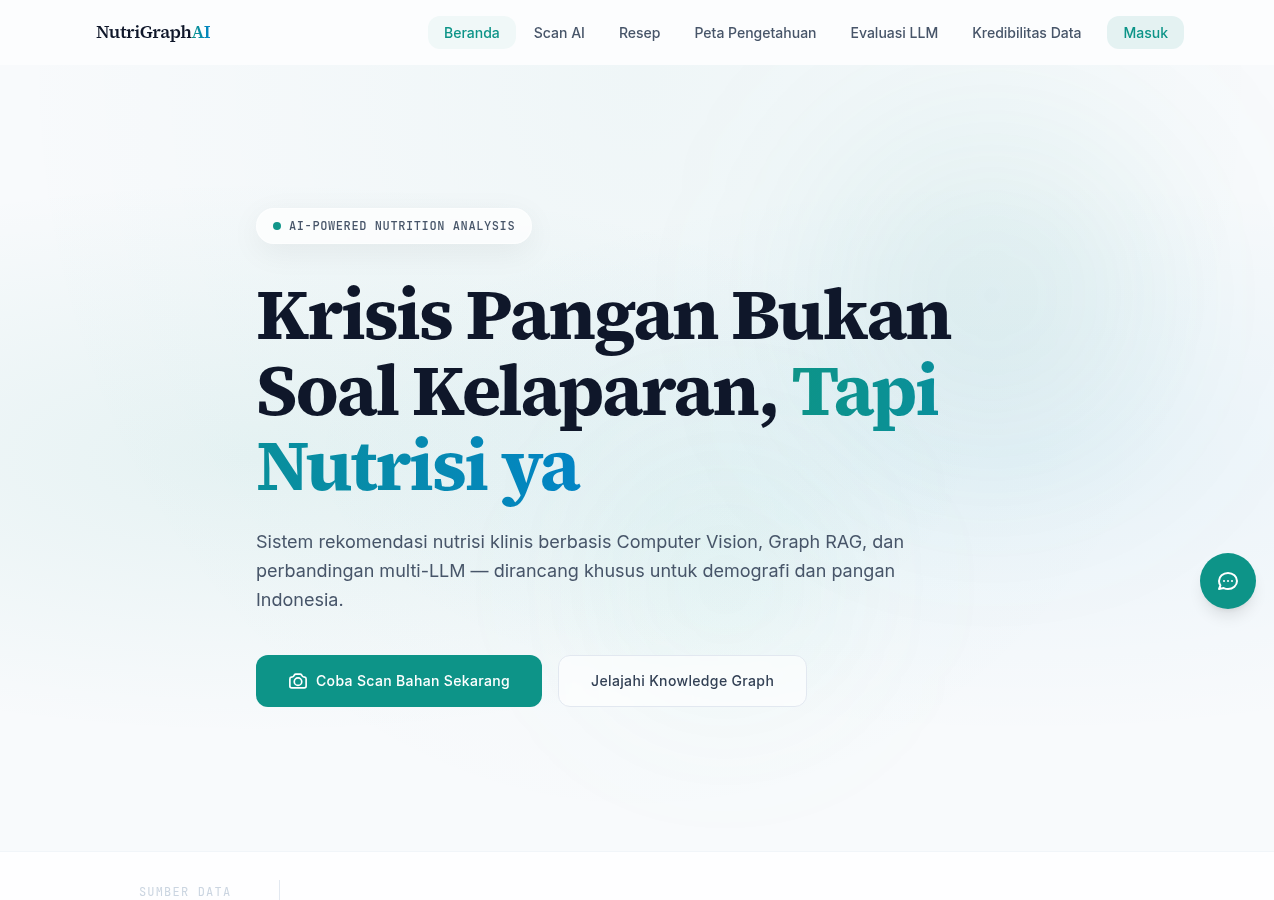
What I Built
Indonesia faces a double burden of malnutrition (21.6% stunting, 19.5M diabetes patients) and existing apps cannot map local food to clinical conditions. I built the complete thesis system that does: food photo → CV recognition → Graph RAG clinical reasoning → multi-LLM recommendations with an evaluation framework measuring answer quality.
Knowledge graph with 251 nodes and 792 relationships in Neo4j — modeling ingredients, nutrients, medical conditions, chemical reactions, and dataset sources for Indonesian foods.
Curated clinical database of 42 local ingredients (bayam, tempe, ayam, salmon, etc.) with per-100g macro and clinical values, each traceable to a dataset source.
Multi-LLM generation pipeline running 3 models in parallel — DeepSeek and Qwen via OpenRouter, Llama 3.3 via Groq Direct — with explicit failure states that never fabricate clinical content.
Evaluation framework with Official RAGAS (faithfulness, answer relevance) over a 15-question clinical benchmark plus a separate custom LLM-as-a-Judge, migrated to Qwen on OpenRouter at USD 0.00004247 per judge call.
Computer vision recognition via Qwen2.5-VL with CLIP visual similarity verification (openai/clip-vit-base-patch32) reaching 0.965 final similarity on real food photos, backed by a versioned similarity cache.
Three-service architecture (Next.js frontend, Express gateway, FastAPI AI engine) with Redis caching (graph provenance TTL 300s), PWA installability scoring Lighthouse 100, and 104 passing Python tests at deploy time.